
Make Christians Vegan Again
Be Fruitful. Multiply Greatly.
Before MAGA and MAHA. Let's go back to "in the beginning...”
Page one. Chapter one. Verse twenty-nine.
The creation narrative builds like a symphony...
...light, sky, water, land, creature...
each day a crescendo — until it arrives at its final, defining note.
The climax of the first chapter of the first book of the most printed, read, and influential text on the face of the earth — the Bible.
God steps back, surveys everything he has made, and delivers the mandate:
"I give you every seed-bearing plant on the face of the whole earth, and every tree that has fruit with seed in it. They will be yours for food." — Genesis 1:29
A mandated plant-based paradise.
Called very good...
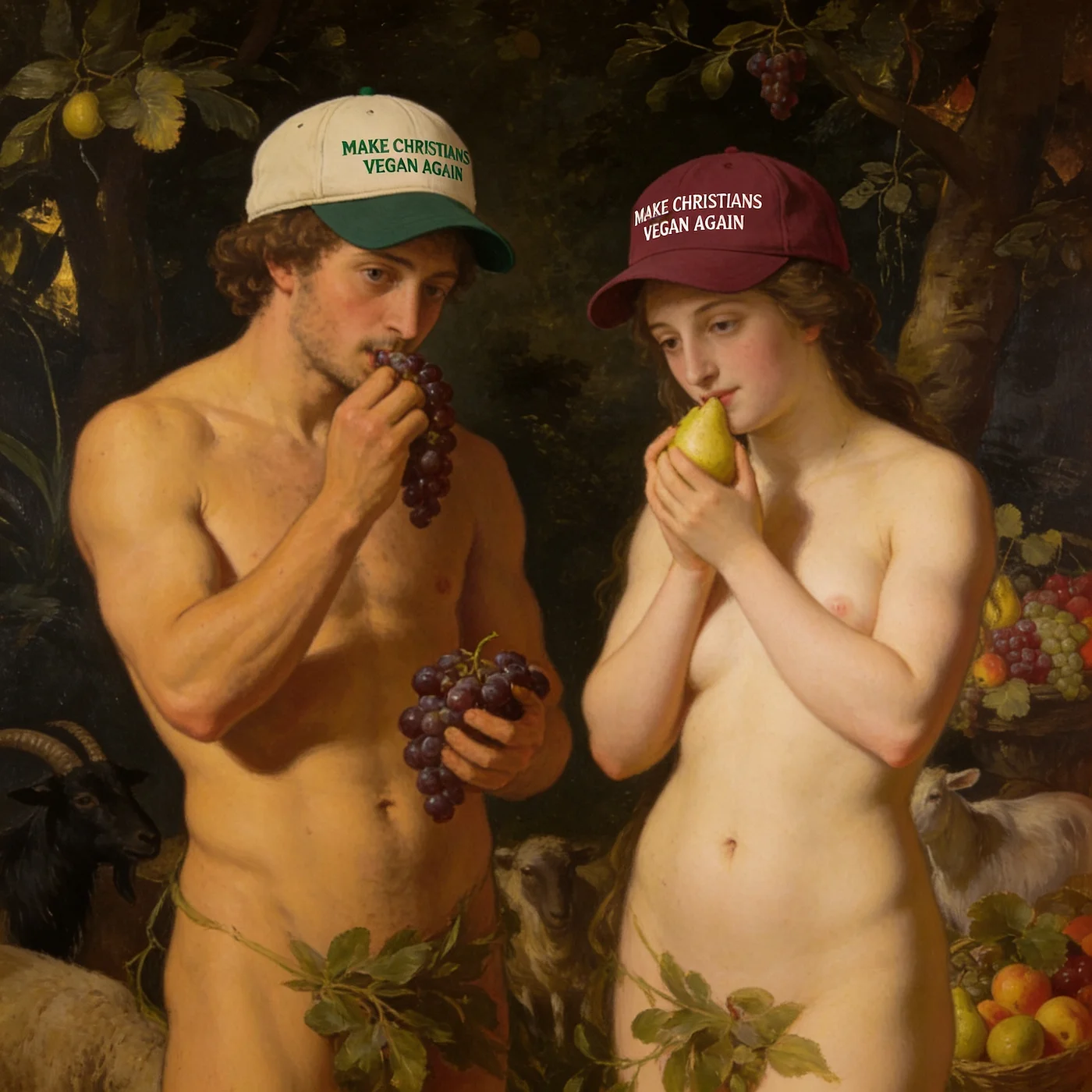
True Dominion
Those same verses — Genesis 1:26-29, the one where God grants "dominion" — contain the entire original blueprint in three movements: stewardship in service to creatures, a plant-based food mandate, and the instruction to be fruitful and multiply. No domination. Not slaughter. Steward. Multiply. Bear fruit.
The plant-based mandate isn't buried in footnotes. It's the headline of the whole story. Everything that came after — the blood, the altars, the sacrifice — was the deviation. We're going back to the source.
First, know who we're talking about.
The movement Jesus launched didn't call itself Christianity. The spiritual path was called The Way — referenced throughout Acts as ha-derekh, a living tradition of practice, not just belief. The people who walked it were the Nazarenes — or in their earliest Aramaic form, Nasaraeans — documented before Rome even had a name for them. Their congregation was the Ebionim — meaning the poor ones, those who chose covenant over empire. The name Christians came later, coined by outsiders in Antioch, and it stuck. But the roots go deeper than that name.
James — the brother of Jesus, who knew him better than any bishop or pope ever would — led the Nazarene movement from Jerusalem. And what the Nazarenes believed, lived, and ate matters enormously. Because we actually know.
Don't take our word for it. Take theirs:
Epiphanius of Salamis, the 4th-century bishop who documented early Christian sects firsthand, records in Panarion 18 that the Nasaraeans "do not offer sacrifice and do not eat flesh, holding it unlawful." Not a preference. Not a cultural habit. Unlawful. This is the movement James led. This is the root of the tree.
Hegesippus, the 2nd-century church historian, records James himself:
"He was holy from his mother's womb. He drank no wine or strong drink, nor did he eat flesh." (In Eusebius, Ecclesiastical History 2.23.5)
Eusebius confirms it in Proof of the Gospel 3.5 — the apostles "gave up their crafts and their means of livelihood... abstaining from the flesh of animals."
And then there's the first secular eyewitness. Before the outside world called them anything, they were The Way. But by 112 CE, a Roman governor named Pliny the Younger — writing to Emperor Trajan — had a name for them: Christiani. The Latin word for Christian. Its first recorded use in history. Pliny describes these Christiani gathering before dawn, singing hymns to Christ, taking oaths against fraud and theft, shutting down the animal sacrifice temples — and eating "innocent and harmless food." (Letters X.96)
Innocent. Harmless. The first Christians by name — on record — eating without blood on their hands.
But Trajan's response reveals something darker. He instructs Pliny to command the Christiani to supplicate the gods — Roman code for animal sacrifice and the consumption of sacrificial flesh. Those who refused faced torture and death. The temples that had gone quiet from lack of demand — the animals unbought, the altars cold — were now doing business again, because people were being forced to choose between their convictions and their lives.
The original Christians didn't just eat differently. They were killed for it.
Which is exactly why they needed a secret...
x>
This symbol goes back further than the cross.
Before the cross was ever worn around anyone's neck, the early followers used a fish. Not as decoration — as a lifeline. Under Roman persecution, identifying yourself as Christiani meant risking everything. So they developed a silent handshake drawn in the dirt: one person traces a single arc with their sandal. If the other completes it into a fish — you're safe. You're family. You're The Way.
The symbol was ICHTHYS — the Greek word for fish, and an acronym hiding in plain sight: Iesous Christos Theou Yios Soter. Jesus Christ, Son of God, Savior. Five words. One fish. The most dangerous piece of graffiti in the Roman Empire.
But the fish wasn't just a code. It was woven into the gospels as the central metaphor for the entire mission. Jesus didn't call fishermen to keep fishing. He called them to stop. "Follow me, and I will make you fishers of men." (Matthew 4:19) The nets they dropped — the catch they walked away from — became the symbol of a movement that would spread faster than Rome could stop it. You weren't catching fish for a fry. You were fishing for people. Multiplying the mission.
And for the Pythagoreans — whose mathematics deeply shaped early Christian thought, as both Philo and Josephus document — the fish carried an even deeper resonance. In John 21, the disciples haul in exactly 153 fish. Not a round number. A very specific one. To a Pythagorean, 153 is a triangular number — the sum of every integer from 1 to 17 — embedded in the sacred geometry of the vesica piscis, the overlapping circles that generate the fish shape itself. The ratio of its width to height: 265 to 153. An approximation of the square root of 3. The mathematics of life, proportion, and divine multiplication — hidden inside the number of fish in a net, in the pages of a gospel, waiting for someone to notice...

x> — a more angular fish for a new generation of anglers.
X is the ancient symbol for Christ — it's why we write Xmas. Jesus in Greek is Christos, beginning with Chi (X). > is the greater than symbol. As in: "You will do even greater things than these." (John 14:12)
X means multiply. But paired with > — greater than — it's not just multiplication. It's multiplication exponentially. X to the power of greater than. Which is exactly how Jesus described the kingdom working.
Together: Multiply Greatly. Straight from Genesis 48:4 — "I will make you fruitful and increase your numbers" — and Acts 6:7 — "the number of disciples multiplied greatly in Jerusalem." And here's what has fascinated scholars for years: the Hebrew verb used for "multiply greatly" in Genesis 48:16 is yidgu (יִדְגּוּ), from the root dagah (דָּגָה) — to multiply like fish — from dag (דָּג), the Hebrew word for fish itself. Multiplication and fishing were literally the same word. That's why Jesus chose fishermen. That's why he multiplied loaves and fish. That's how the kingdom spreads — not by force, but exponentially, organically, unstoppably.
XV in Roman numerals is 15 — the number of the millennial kingdom in gematria. And the millennial kingdom isn't just an abstraction. Isaiah 11 — the very prophecy that named the Nazarene through the Hebrew word netser (נֵצֶר, the Branch of Jesse, the Christ) — describes that kingdom in vivid, specific terms: the wolf lying with the lamb, the lion eating straw like the ox, a child leading them, "and they shall not hurt or destroy in all my holy mountain." No predation. No slaughter. The original design restored.
Irenaeus of Lyons preserved a saying of Jesus about this age, transmitted through Papias who heard it directly from John the disciple: that the coming kingdom would produce vines of ten thousand branches, grain of ten thousand ears — and that "all the animals using these foods drawn from the earth will in turn become peaceful and harmonious with one another." (Against Heresies 5.33.3-4) The animals return to the original food. Just like humans. The whole creation coming back to Genesis 1:29. Jesus said this. John remembered it. Irenaeus recorded it.
X marks the spot. And > is just a sideways V for vegan.
One more thing. X is also the symbol of the straight edge movement — the punk rockers who rejected alcohol, drugs, and animal products. Who chose clarity, conviction, and refusal to participate in systems of harm. Sound familiar? James the Nazarene didn't drink wine, didn't eat flesh, from birth. The original straight edge. Now X and > together mean something new: Jesus is Vegan. Possibly the most punk rock, counter-cultural, disruptive thing you could say in 2024. And also the most historically accurate.
Here's what we're actually building.
The kingdom of heaven isn't coming later. It's latent — already here, pressing through the surface, waiting for enough people to recognize it at once.
Before the MAHA movement, before the wellness revolution, the MAHArishi proved it scientifically: when a critical mass of people shift their consciousness, the whole field shifts with them. Crime drops. Coherence rises. The system tips. They called it the Maharishi Effect. Jesus called it yeast in dough.
Jesus described it as yeast moving invisibly through a loaf until the whole thing has risen. A mustard seed becoming a tree large enough for every bird to nest in. A harvest so overwhelming it outpaces the harvesters. And he gave the operating logic plainly: "Whatever you ask in prayer, believe that you have received it, and it will be yours." (Mark 11:24) Not will receive. Have received. Present tense. Because "the kingdom of God is in your midst." (Luke 17:21) It's already here. And if you have faith the size of a mustard seed, you can speak to mountains and they move. (Matthew 17:20)
This is the logic of the hat. This is the mantra of the movement. Not wishful thinking — the exponential mathematics of enough aligned conviction reaching critical mass.
Genesis 1:29 was always the blueprint. The Nazarenes lived it. Pliny documented it. Epiphanius confirmed it. The apostles embodied it. The brother of Jesus practiced it from birth. Isaiah prophesied its return. Jesus described its fullness in terms of exponential abundance — grains, grapes, and peaceful animals, all the way down.
And for two thousand years, most of the church forgot it.
We're here to remember. And to multiply.
Welcome to MXVA. Make Christians Vegan Again. Be Fruitful. Multiply Greatly.